Thomas Middleton
Killers of the Flower MoonThomas Middleton’s role in the murder of Mary DeNoya-Bellieu-Lewis reaches the reader through a family-compiled manuscript discovered decades later in a Pawhuska library. The account identifies him as the plot’s instigator: after Lewis disappeared, he tried to exploit her money and planned to turn her death into a means of claiming her headright payments. His case places a documented headright killing in 1918, years before the period commonly called the Reign of Terror was thought to begin.
The Murder of Mary DeNoya-Bellieu-Lewis
In the summer of 1918, Lewis, born in 1861 and an allotted member of the Osage tribe, traveled to Liberty, Texas, with her ten-year-old adopted daughter. Middleton, described as her friend, and another white man accompanied them. Using Lewis’s money, the group bought a houseboat and stayed on the river. On August 18, Lewis vanished. The account gives no resolution to what happened to her daughter during the ensuing investigation, but it records that local authorities initially failed to pursue the disappearance, prompting Lewis’s family to hire a private detective.
The detective uncovered a financial deception: after Lewis disappeared, Middleton had pretended to be her adopted son in order to cash several of her checks. When police detained Middleton and his companion in January 1919, the detective questioned them and urged Middleton to provide information that might locate Lewis alive. Middleton denied knowing where she had gone and said he was not afraid. Neither man disclosed what had happened.
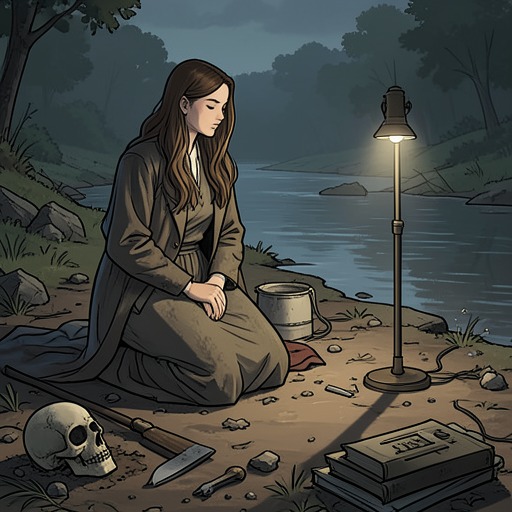
Witnesses supplied a lead that the detained men had withheld. They had seen a car heading toward a snake-infested swamp a few miles from the houseboat on the day Lewis disappeared. On January 18, investigators searched the thick vegetation and bayou. They recovered human remains, including a skull that appeared to have been struck with a heavy metal object. Middleton’s companion then confessed to beating Lewis over the head with a hammer. The account identifies Middleton as the person who conceived the plan: after the killing, a female associate was to impersonate Lewis so the group could collect her headright payments.
Conviction and Historical Significance
In 1919, Thomas Middleton was convicted of Mary DeNoya-Bellieu-Lewis’s murder and condemned to die. His sentence was commuted to life imprisonment. After he had served only six and a half years, the governor of Texas pardoned him. Lewis’s family believed Middleton’s girlfriend had bribed officials; the surviving account records that belief, not proof of a bribe. To the family, the pardon turned the apparent end of the ordeal into renewed disbelief and anger: the man convicted of the killing had escaped the punishment they thought the crime warranted.
Middleton’s case also widened the chronology of Osage murders for headrights. Lewis was killed in 1918, at least three years before the spring of 1921, when the Reign of Terror is commonly said to have begun. Her murder therefore complicates any account that treats the killings as a single conspiracy beginning with William K. Hale. The book presents Middleton’s plot as evidence of a broader pattern: other killings over headrights occurred beyond Hale’s operation, and some were never investigated or even classified as homicides.
Headrights and Financial Control
Middleton’s case unfolded within a system that both restricted Osage access to their own wealth and made that wealth a target for fraud. The federal government required the Office of Indian Affairs to decide which Osage people were “incompetent”; in practice, guardianship was usually imposed according to blood quantum. Full-blooded Osage were routinely assigned white guardians who could oversee spending down to ordinary purchases, while mixed-blood people rarely faced the same rule. In 1921, Congress added annual limits on withdrawals from the trust funds of Osage people under guardianship, even when they needed money for education or medical care. These controls came after Lewis’s 1918 killing, but they show the broader contradiction surrounding Osage wealth: the government curtailed the owners’ control while the wealth remained exposed to people seeking to appropriate it.
The book places Middleton’s scheme alongside a recurring problem of false claims to Osage inheritance. After Bill Smith died in a house explosion, the government initially feared that a relative claiming to be his heir was an impostor. Such cases make the attempted impersonation in Lewis’s murder part of a wider pattern of fraud around headrights, rather than an isolated device. The distinction matters: the evidence identifies Middleton’s role in one plot, while the surrounding cases show how vulnerable inheritance claims could become wherever wealth, identity, and legal oversight converged.
The Manuscript as a Record
The surviving account of Middleton’s crime entered the book through a spiral-bound manuscript found in the Pawhuska public library among volumes of Osage history. Anna Marie Jefferson, Mary DeNoya-Bellieu-Lewis’s great-great-grandniece, compiled it in January 1998 after first hearing the story from her great-grandmother around 1975. Over the next two decades, she assembled family recollections, newspaper clippings, and other records, preserving a case that might otherwise have disappeared from the historical record. Its account carries details of both the investigation and the family’s response, while also making clear that the story passed through generations before it reached the library. The manuscript’s recovery thus forms part of the case’s significance: it restored evidence of a headright killing that broader histories had left outside their usual chronology.